

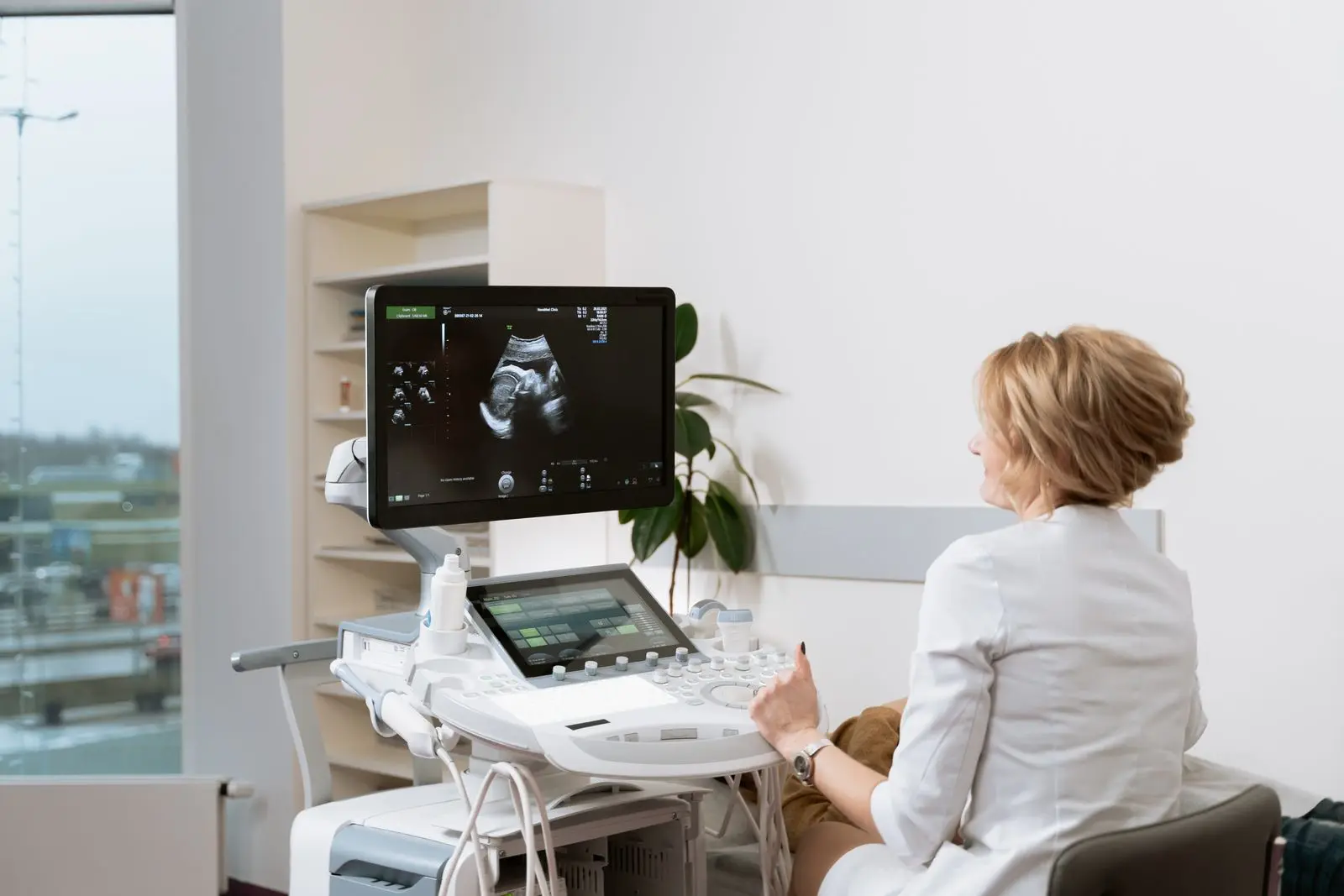

At 20 weeks pregnant, you are halfway. Your baby is about 25.6 cm long, roughly the size of a banana, and weighs about 310 g. For many people, this is also the week of the mid-pregnancy scan, often called the anatomy or anomaly scan.
This is the most detailed scan of pregnancy. This guide explains what the sonographer looks at, what the scan cannot tell you and how to get ready.
Your baby this week
Your baby is covered in vernix and fine downy hair. Hair on the scalp is growing, and the nails are forming on fingers and toes. Your baby swallows amniotic fluid, which helps the digestive system to develop, and the first meconium is collecting in the bowel.
Sleep and waking cycles have begun. You may notice that your baby is more active at certain times, often when you are resting. The nerves connecting the brain to the muscles are becoming more refined, so your baby's kicks and punches feel stronger.
How it happens. By this point, the brain has developed the main areas that will control movement, senses and thought. The connections between them continue to multiply, and this process will carry on long after birth.
Your body this week
Your uterus is at the level of your belly button. Some people notice that their navel is flatter, or that it pops out. This is common, and it usually returns to normal after birth. Your bump is likely more obvious now, and other people may comment on it.
You may feel your baby move often. If you are having your first baby, you may only have felt movement recently. The movements will get stronger, and patterns will appear over the next few weeks.
Common symptoms at 20 weeks
- Regular kicks and rolls. You may notice a favourite time of day for movement.
- A flat or protruding navel. The growing uterus pushes the belly button outward.
- Shortness of breath. Your uterus presses up on your diaphragm, and your body needs more oxygen.
- Thicker hair and nails. Higher hormone levels slow hair loss, so hair may look fuller.
- Heartburn. Slower digestion and pressure on the stomach can increase acid reflux.
- Sleep disturbance. Movement, comfort and worry can keep you awake.
The anatomy scan: what to expect
The scan is usually offered between 18 and 22 weeks. The NHS offers it between 18 weeks 0 days and 20 weeks 6 days, and other systems give a slightly wider window. Your clinic will tell you when yours is.
It takes about 30 to 45 minutes. You lie on a couch, gel is spread on your belly, and a sonographer moves a probe over it. You do not usually need a full bladder. If your baby is in a position where some views are hard to see, you may be asked to walk around or come back for a repeat scan. This is common and does not mean something is wrong.
The sonographer usually checks:
- The brain and head. The shape and structure, including fluid spaces in the brain.
- The face. The lips and profile, to look for a cleft lip.
- The spine. The bones and the skin covering, to look for neural tube conditions such as spina bifida.
- The heart. The four chambers and the major vessels leaving the heart.
- The chest and diaphragm. The lungs and the muscle that separates chest from abdomen.
- The abdomen. The stomach, kidneys, bladder and the wall of the abdomen.
- The arms, legs, hands and feet. Length, position and the presence of fingers and toes.
- The placenta. Where it lies, and how it relates to the cervix.
- The amniotic fluid. Whether the amount looks typical.
- Growth. Measurements of head, belly and thigh bone give an estimate of size.
Many clinics can also tell you the baby's sex, if you want to know. Tell the sonographer before the scan starts if you would prefer not to find out.
What the scan cannot do
The anatomy scan is a detailed look at your baby's structure, but it has limits. It cannot detect every condition, and some problems, such as some heart differences or conditions that develop later, may not be visible at this stage. It also does not test chromosomes directly, and it cannot predict how a baby will do after birth.
Ask your provider how well the scan detects the condition you are most concerned about. Many providers can give you the rates for their own service.
If the scan finds something
Most scans find nothing unusual. If the sonographer finds something that needs a closer look, you will usually be referred for a second scan with a specialist. Not every finding is serious. Some are minor variations that resolve, and others need only monitoring. A few need treatment, planning for where you give birth, or extra support.
If this happens, you may feel shocked or scared. It can help to:
- Ask for the finding in writing and for the name of any condition, so you can look it up in reliable places.
- Ask what the next steps are, and when.
- Bring someone to the follow-up appointments.
- Ask about support, such as counselling, specialist teams and peer groups.
Your week 20 checklist
Call your provider
Call your provider if you have bleeding, severe belly pain, fluid leaking, a fever, a severe headache or changes in vision. Call if you notice your baby's movements have changed after you have started to feel them regularly. This guide is general information and does not replace medical advice.
Frequently asked questions
What does the 20-week scan check for?
The baby's brain, face, spine, heart, chest, abdomen and limbs, the placenta and the amniotic fluid, as well as growth.
Can the anatomy scan find everything?
No. It is a detailed check of structure and can find many conditions, but it cannot detect all of them, and it does not test chromosomes directly.
Why does baby length jump at 20 weeks?
Because many sources switch from measuring crown to rump to measuring head to heel at this point. Your baby has not grown 10 cm in a week.
Sources
Sources: NHS: 20 weeks pregnant; Mayo Clinic: Fetal development, the second trimester; Cleveland Clinic: Fetal development, week-by-week stages of pregnancy